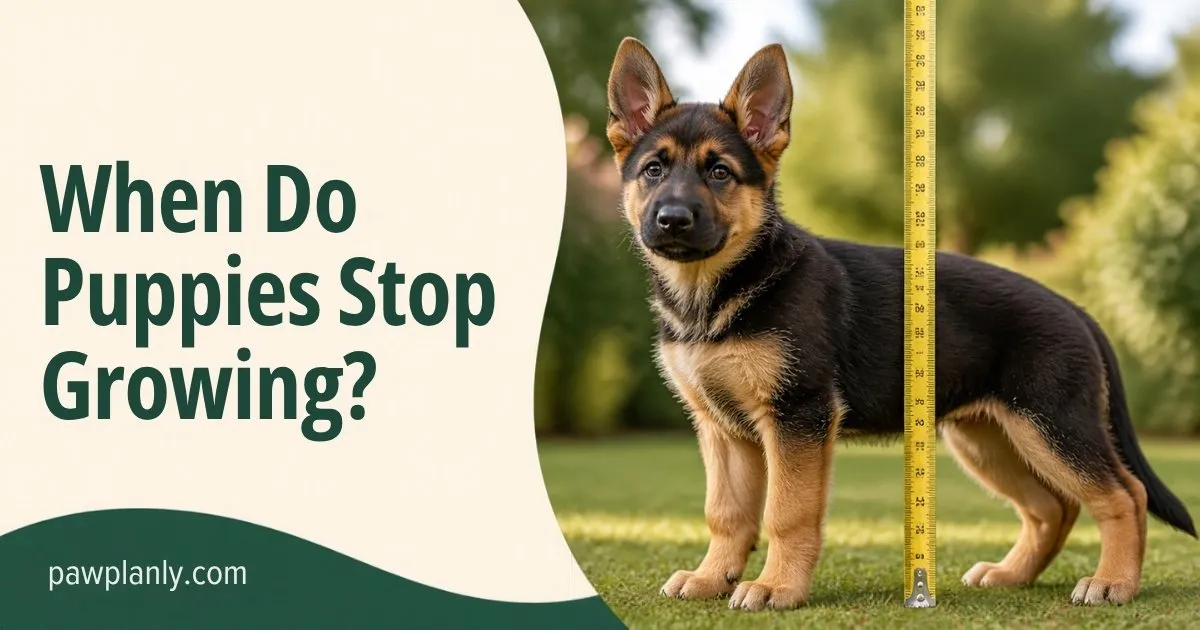
The best predictors of your puppy’s adult size are its parents, its breed, and how fast it is growing now. As a rough guide, small breeds reach about half their adult weight by 3–4 months, while giant breeds take 5–6 months and keep growing until about 2 years old.
For a quick estimate, use our Puppy Weight Calculator.
Why puppies of different sizes grow differently
Every puppy follows a growth curve: very fast growth early on, then a gradual slowdown. A study that tracked the weight of puppies from a range of breeds as they grew (Hawthorne et al., 2004) found that bigger breeds take longer to reach adult weight. Small breeds got there at about 9–10 months, while the largest breeds took about 11–15 months.
In practice, many large and giant breed dogs keep filling out with muscle for longer, often until 18–24 months. That’s why the chart below assumes slower growth for them.
So a 4-month-old Chihuahua and a 4-month-old Great Dane are at very different points in their growth, even though they are the same age.
Puppy growth chart by size
This chart shows the approximate share of adult weight puppies reach at each age:
| Age | Toy/small | Medium | Large | Giant |
|---|---|---|---|---|
| 2 months | 30% | 25% | 20% | 15% |
| 3 months | 45% | 37% | 30% | 24% |
| 4 months | 60% | 50% | 42% | 34% |
| 6 months | 82% | 72% | 63% | 53% |
| 8 months | 94% | 86% | 78% | 68% |
| 10 months | 99% | 95% | 89% | 80% |
| 12 months | 100% | 99% | 95% | 88% |
| 18 months | 100% | 100% | 100% | 98% |
These are typical patterns, not exact rules. Your puppy may grow a little faster or slower. For typical weights of 20 popular breeds, see our puppy growth chart by breed.
How to use the chart
Divide your puppy’s current weight by the percentage for its age and size.
Example: a large-breed puppy weighing 30 lb at 4 months has probably reached about 42% of its adult weight. 30 ÷ 0.42 ≈ 71 lb as an adult.
Our puppy weight calculator does this for you, including ages in weeks, and gives a likely range.
Other clues to your puppy’s adult size
- The parents: the strongest clue. Puppies usually end up close to their parents’ size.
- Breed standard: for purebreds, breed clubs list typical adult weights.
- DNA test: for mixed breeds, it can reveal the breeds in the mix and their typical sizes.
- Paws: big paws can hint at a big dog, but they’re not reliable on their own.
When do puppies stop growing?
Height usually stops increasing before weight does. Many dogs reach their full height around the time their growth plates close, often between 8 and 18 months depending on size. After that they keep “filling out” with muscle. Giant breeds can take up to 2 years to mature fully. For ages by size group, height and growth plates, read when do puppies stop growing?
Feeding a growing puppy
Good nutrition matters more than fast growth:
- Feed a food made for growth. For large and giant breeds, choose one labeled for large breed puppies. These control calcium and calories to support steady growth.
- Keep your puppy lean. You should be able to feel the ribs easily and see a waist.
- Measure portions. Start with our dog food calculator (choose a “Puppy” option), then adjust based on body condition.
- Don’t overdo supplements. Extra calcium can harm large breed puppies unless your vet prescribes it.
When to talk to your vet
Ask your vet if your puppy:
- Seems to be growing much slower or faster than expected
- Is very thin or looks overweight
- Limps, has swollen joints or seems stiff
- Has a poor appetite, vomiting or diarrhea
The bottom line
Your puppy’s adult size is mostly set by its genes. Growth charts and calculators give a useful estimate, and the parents’ size is the best clue of all. Focus on steady, lean growth rather than size. Estimate your puppy’s adult weight →
Frequently asked questions
At what age is a puppy half its adult weight?
Roughly 3–4 months for small breeds, about 4 months for medium breeds, 4–5 months for large breeds and 5–6 months for giant breeds. Individual puppies vary.
How can I tell how big my mixed-breed puppy will get?
Use a growth calculator as a rough guide, ask the shelter or breeder about the parents' size, and consider a dog DNA test to learn which breeds are in the mix. Your vet can also compare growth at each visit.
Is the 'double the weight at 16 weeks' rule accurate?
It's a rough rule that works best for small and medium dogs. Large and giant breeds keep growing for longer, so doubling their 16-week weight usually underestimates their adult size.
Should I feed my puppy more so it grows bigger?
No. Feeding more doesn't change a puppy's genetic adult size, but it can make it overweight. In large and giant breeds, it can raise the risk of bone and joint problems. Keep puppies lean.
Sources
This guide is for general information and does not replace advice from your veterinarian. If you are worried about your pet, contact your vet. How we write our guides.