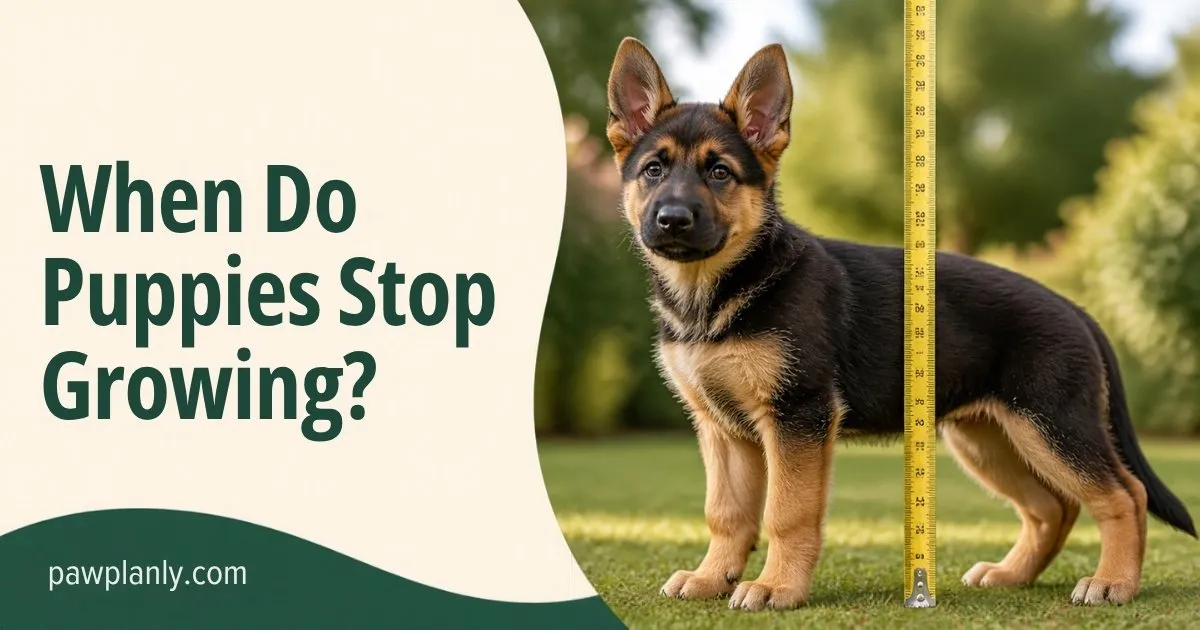
Most puppies stop growing between 9 and 24 months of age, and the bigger the breed, the longer it takes. Small breeds are usually fully grown at about 10–12 months, while giant breeds like Great Danes can keep filling out until about 2 years old.
To see how much more your own puppy is likely to grow, enter its age and weight in our Puppy Weight Calculator. For growth charts and other clues to adult size, read how big will my puppy get?
When do puppies stop growing? Quick answer by size
| Size group (adult weight) | Examples | Close to adult weight | Fully grown |
|---|---|---|---|
| Toy/small (under 20 lb / 9 kg) | Chihuahua, Shih Tzu, Yorkie | 9–10 months | 10–12 months |
| Medium (20–50 lb / 9–23 kg) | Beagle, Border Collie, Cocker Spaniel | 10–12 months | 12–15 months |
| Large (50–90 lb / 23–41 kg) | Labrador, Golden Retriever, German Shepherd | about 12 months | 15–18 months |
| Giant (over 90 lb / 41 kg) | Great Dane, Mastiff, Newfoundland | 11–15 months | 18–24 months |
The “close to adult weight” ages come from a study that tracked puppies of many breeds as they grew (Hawthorne et al., 2004). Small breeds reached adult weight at about 9–10 months, and the largest breeds took about 11–15 months. The “fully grown” column is our estimate from typical growth curves, because big dogs keep adding muscle after their weight gain slows down.
Why big breeds grow for longer
A Great Dane has to gain many more pounds than a Chihuahua to reach adult size, so it needs more months to get there.
All puppies grow very fast in the first few months and then slow down. The AAHA life stage guidelines describe the puppy stage as lasting from birth until rapid growth ends, at about 6–9 months depending on breed and size. After that, growth continues more slowly until the dog reaches its adult size.
When do puppies stop growing in height?
Height usually stops before weight. A puppy grows taller as the growth plates near the ends of its long leg bones add new bone. When those plates close, the bones stop getting longer.
In a study of 15 dog breeds (Geiger et al., 2016), the growth plate at the shoulder end of the upper front leg bone closed at about 10–11 months in most breeds, and earlier, at 8–9 months, in Dachshunds. Other published studies give a range of about 8.5 to 14 months.
So most dogs are close to their full height by about 1 year. After that, they “fill out”: their chest gets deeper and they build muscle, which is why a large breed dog can still gain weight at 18 months without getting any taller.
Growth plates, exercise and spay/neuter timing
Open growth plates are softer than mature bone, so a growing puppy’s joints need a bit of care:
- Let your puppy play freely on soft ground, but avoid long forced runs, repeated high jumps and jumping down from heights until your vet says growth is done.
- Watch large and giant breeds most closely. They grow for longer and carry more weight on still-growing joints.
- Ask about spay/neuter timing. Spaying or neutering before the growth plates close can delay their closure. For dogs expected to weigh 45 lb (20 kg) or more, AAHA suggests neutering males after growth stops, at about 9–15 months, and spaying females between 5 and 15 months. For smaller dogs, AAHA suggests about 5–6 months. Your vet will help you pick the right age.
When is a dog fully grown mentally?
A dog’s mind matures more slowly than its body. AAHA says most dogs finish their physical and social maturing by 3 to 4 years of age.
That is why a dog that looks fully grown at 1 year can still act like a teenager: jumping on people, chewing, barking and testing rules. AAHA notes that the period from about 6 months to 3 years is often the most challenging for owners. Patient training and plenty of exercise and play help a lot.
Signs your puppy is almost done growing
- Weight gain slows down. Weigh your puppy every 2–4 weeks. When the number barely changes for a couple of months, growth is nearly over.
- Adult teeth are in. Most permanent teeth come in by about 6–7 months. This shows your puppy is past the fastest growth, not that it is done.
- Paws and body look in proportion. Puppies often look leggy or have big paws for a while, then the body catches up.
- Your puppy matches its expected adult size. Our puppy weight calculator estimates that number from age and current weight.
Popular breeds: when they stop growing
- Shih Tzu, Yorkie, Chihuahua (small): close to adult weight by about 9–10 months.
- Dachshund: its leg bones stop growing early, at about 8–9 months. It may keep filling out for a few more months.
- Beagle, Border Collie (medium): about 12–15 months.
- Labrador and Golden Retriever (large): close to adult weight around 12 months, and fully filled out at about 15–18 months.
- German Shepherd (large): about 15–18 months; some males keep filling out longer.
- Goldendoodles and other doodles: depends on the poodle parent. A Standard Poodle mix usually grows like a large breed; a Miniature or Toy Poodle mix grows like a small or medium dog.
- Great Dane, Mastiff, Bernese Mountain Dog (giant): about 18–24 months.
These are typical ages, not exact rules. Each puppy grows at its own pace.
When to switch to adult dog food
Keep feeding a puppy (growth) food until your puppy is close to its adult size, then switch to an adult food. For small breeds this is often around 9–12 months; for large and giant breeds it is often later. Ask your vet when your dog is ready.
While your puppy grows:
- Large and giant breed puppies should eat a food labeled for large breed puppies. These foods control calcium and calories to support steady growth.
- Keep your puppy lean. You should feel the ribs easily and see a waist from above. Feeding extra does not make a dog grow bigger, and too much food can push large breed puppies to grow too fast.
- Measure meals. Use our dog food calculator (choose a puppy option) as a starting point, and read how much should I feed my dog? for how to adjust portions.
When to call the vet
Talk to your vet if your puppy:
- Stops gaining weight, or loses weight, while it should still be growing
- Looks much smaller or bigger than expected for its breed and age
- Limps, has swollen joints, or seems stiff after rest
- Has legs that look bowed, twisted or uneven
- Has a poor appetite, vomiting or diarrhea
Your vet can weigh your puppy at each visit, check its joints and tell you when it is fully grown.
The bottom line
Small dogs are usually fully grown by about 1 year, while large and giant breeds keep growing until about 18–24 months. Height stops first, around 10–12 months for most dogs, and weight and muscle follow. To see how much growing your puppy has left, try the Puppy Weight Calculator.
Frequently asked questions
At what age is a dog fully grown?
It depends on size. Small breeds are usually fully grown at about 10–12 months, medium breeds at about 12–15 months, large breeds at about 15–18 months and giant breeds at about 18–24 months. Most dogs reach their full height by about 1 year and then keep filling out.
When do puppies stop growing in height?
Most puppies reach their full height at about 10–12 months, when the growth plates in their long leg bones close. In a study of 15 breeds, a main growth plate in the front leg closed at about 10–11 months in most breeds and at 8–9 months in Dachshunds. Weight and muscle can keep increasing after height stops.
When is a dog fully grown mentally?
Later than its body. The American Animal Hospital Association (AAHA) says most dogs finish physical and social maturing by 3 to 4 years of age. The time from about 6 months to 3 years is often the hardest for owners, because dogs are still learning to manage their behavior.
When do Goldendoodles and other doodles stop growing?
It depends on the size of the poodle parent. A doodle with a Standard Poodle parent usually grows like a large breed and is fully grown at about 15–18 months, while one with a Miniature or Toy Poodle parent grows like a small or medium dog and finishes at about 10–15 months.
Does spaying or neutering affect growth?
Spaying or neutering before the growth plates close can delay their closure, so the leg bones may grow a little longer. For dogs expected to weigh 45 lb or more, AAHA suggests neutering males after growth stops (about 9–15 months) and spaying females between 5 and 15 months. Ask your vet about the right timing for your dog.
Sources
- Hawthorne A.J. et al. (2004), Body-Weight Changes during Growth in Puppies of Different Breeds, Journal of Nutrition
- Geiger M. et al. (2016), Unaltered sequence of dental, skeletal, and sexual maturity in domestic dogs compared to the wolf, Zoological Letters
- AAHA: 2019 Canine Life Stage Guidelines (PDF)
- Merck Veterinary Manual: Nutritional Requirements of Small Animals
This guide is for general information and does not replace advice from your veterinarian. If you are worried about your pet, contact your vet. How we write our guides.