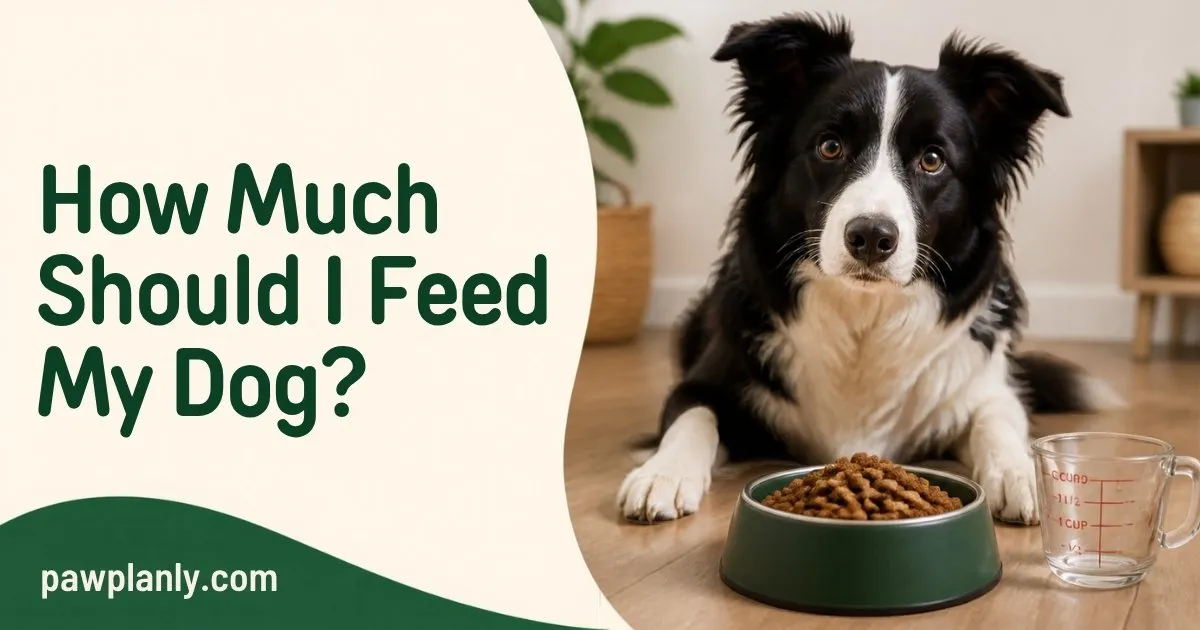
The short answer: a typical spayed or neutered adult dog needs roughly 20–35 calories per pound of body weight per day. Small dogs are near the top of that range, and large dogs near the bottom. But the right amount for your dog depends on its weight, age, activity and the food you use. In this guide you’ll learn how to work it out and how to tell whether you’ve got it right.
If you just want a number, use our Dog Food Calculator. It does the math in seconds.
Why the amount on the bag is only a starting point
Feeding charts on dog food bags cover a huge range of dogs, from couch-loving seniors to young, active dogs. To make sure no dog goes hungry, they’re often on the generous side. That is one reason so many pet dogs are overweight: surveys by the Association for Pet Obesity Prevention estimate that over half of US dogs are overweight or obese.
Use the bag as a starting point, then adjust based on your dog.
How vets calculate how much a dog needs
Veterinarians use a simple two-step method.
Step 1: Resting Energy Requirement (RER). This is the energy your dog burns at rest:
RER = 70 × (weight in kg)^0.75
Step 2: Multiply by a life-stage factor. This gives daily calories:
| Your dog | Factor |
|---|---|
| Puppy under 4 months | 3.0 × RER |
| Puppy 4–12 months | 2.0 × RER |
| Spayed/neutered adult | 1.6 × RER |
| Intact adult | 1.8 × RER |
| Senior or less active | 1.2–1.4 × RER |
| Weight loss | 1.0 × RER (at ideal weight) |
| Working dog | 2.0–5.0 × RER |
Example: a 44 lb (20 kg) neutered adult dog has an RER of about 662 kcal. Multiplied by 1.6, that’s about 1,060 calories a day.
Converting calories to cups
Every dog food has a different calorie density. In the US, the bag must show a calorie content statement, usually in kcal/kg and kcal/cup.
Cups per day = daily calories ÷ kcal per cup
With a 380 kcal/cup food, our 44 lb dog needs 1,060 ÷ 380 ≈ 2.8 cups a day. If you switch to a 450 kcal/cup food, the same dog needs only about 2.4 cups. That’s why you should always recalculate when you change foods.
Tip: use a real measuring cup, or better, a kitchen scale. “One scoop” can easily be 20–30% more than a cup.
Dog feeding chart by weight
Approximate daily amounts for a spayed/neutered adult dog eating a 380 kcal/cup dry food:
| Weight | Calories/day | Cups/day |
|---|---|---|
| 10 lb | ~350 | ~0.9 |
| 20 lb | ~590 | ~1.5 |
| 30 lb | ~800 | ~2.1 |
| 50 lb | ~1,170 | ~3.1 |
| 70 lb | ~1,500 | ~4.0 |
| 90 lb | ~1,810 | ~4.8 |
Notice that a 90 lb dog doesn’t need nine times as much food as a 10 lb dog. Bigger bodies are more energy-efficient, which is why the formula uses weight to the power of 0.75.
How often to feed
- Puppies under 4 months: 4 meals a day
- Puppies 4–6 months: 3 meals a day
- Puppies over 6 months and adults: 2 meals a day
Splitting food into two meals keeps hunger steady. For large, deep-chested breeds like Great Danes, it may also lower the risk of bloat compared with one big meal.
Don’t forget treats
Treats, chews and table scraps add up quickly. Most vets recommend keeping them to 10% or less of daily calories. For a dog eating 1,000 calories a day, that’s about 100 calories, which can be just a few biscuits. If you give a lot of treats during training, reduce meals slightly.
Is your dog at the right weight?
The best guide is body condition, not just the scale. A dog at a healthy weight has:
- Ribs you can feel easily with light pressure, without seeing them
- A visible waist when you look down from above
- A belly that tucks up when viewed from the side
If your dog is getting heavier, cut the daily amount by about 10% and re-check in 2–3 weeks. If your dog is too thin, increase by about 10%, and talk to your vet if it doesn’t improve.
Special cases
Puppies
Puppies need more calories per pound, but overfeeding large and giant breed puppies can harm developing bones and joints. Choose a food labeled for growth (including large breed growth if needed), keep your puppy lean, and let your vet track growth.
Seniors
Many older dogs are less active and need fewer calories, often 20–30% less than in their prime. Some seniors lose weight and muscle instead, so regular weigh-ins matter. Our dog age calculator can tell you if your dog has reached its senior years.
Weight loss
For an overweight dog, vets usually calculate calories from the dog’s ideal weight, not its current weight, and aim to lose about 1–2% of body weight per week. Our dog weight loss calculator estimates the ideal weight, diet calories and weeks to goal for you. Always do weight loss with your vet’s guidance.
When to talk to your vet
Contact your vet if your dog has sudden changes in appetite, unexplained weight loss or gain, vomiting or diarrhea, or increased thirst (our dog water intake calculator shows if your dog is drinking more than normal). Also check with them if your dog has a condition like diabetes, kidney disease or pancreatitis, which needs a specific diet.
The bottom line
Start with a calculated amount, measure every meal, count treats, and adjust based on your dog’s body condition every few weeks. Calculate your dog’s daily food now →
Frequently asked questions
How much should a 50 lb dog eat per day?
A spayed or neutered 50 lb adult dog needs roughly 1,150–1,200 calories a day. With a typical 380 kcal/cup dry food, that's about 3 cups a day, split into two meals. Active or intact dogs need more.
Is it better to feed a dog once or twice a day?
Most vets recommend two meals a day for adult dogs. It helps with hunger, keeps energy steady and may lower the risk of bloat in deep-chested breeds compared with one large meal.
Why is my dog always hungry?
Many dogs, especially Labradors, are naturally food-motivated. Some breeds even carry a gene linked to stronger appetite. Constant hunger with weight loss, increased thirst or other changes can signal a medical problem, so check with your vet.
How do I switch dog foods?
Change gradually over about 7 days: mix 25% new food for two days, 50% for two days, 75% for two days, then 100%. Recalculate portions, because calories per cup differ between foods.
Sources
This guide is for general information and does not replace advice from your veterinarian. If you are worried about your pet, contact your vet. How we write our guides.