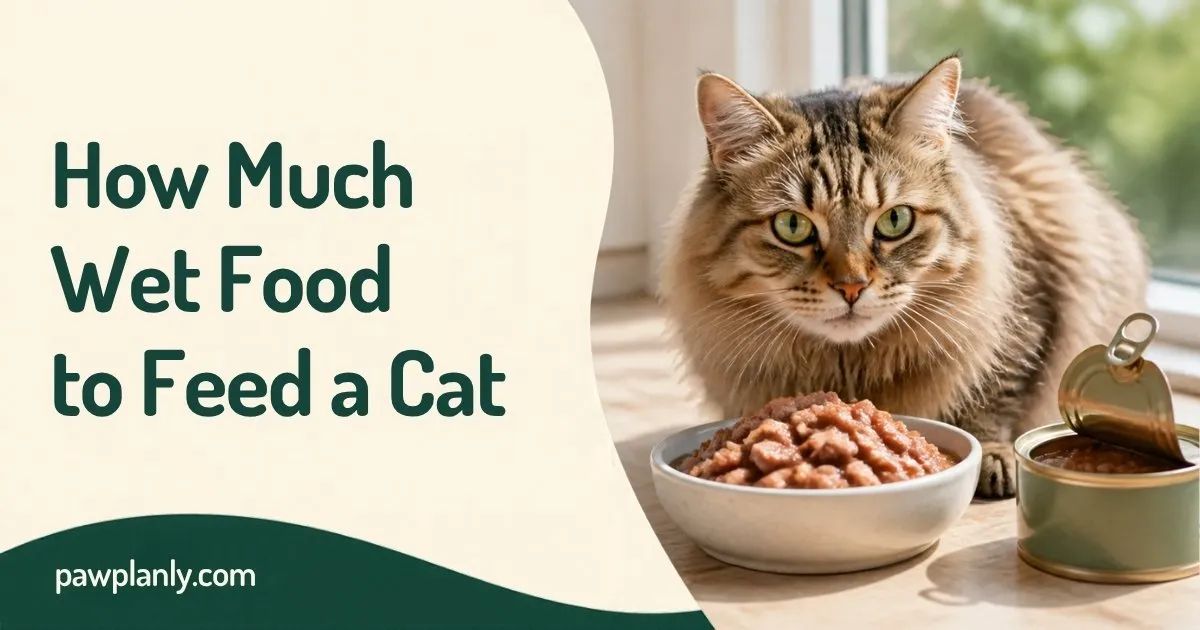
A typical 10 lb spayed or neutered adult cat needs about 220–260 calories a day, which is roughly 3 small (3 oz) cans of wet food or about 1.5–2 large (5.5 oz) cans. The real number depends on your cat’s weight, age and activity, and on the calories in your brand, which can differ a lot between cans of the same size.
For an exact amount, enter your cat’s weight and the kcal per can from the label in our Cat Food Calculator. This guide focuses on wet food only. For dry food and general portions, see how much to feed a cat.
How many cans of wet food a cat should eat a day
Vets start with the Resting Energy Requirement (RER) = 70 × (weight in kg)^0.75, then multiply it by a life-stage factor. Most spayed or neutered adults need about 1.2 × RER. Indoor, less active cats often do better closer to 1.0 × RER.
Daily amounts for an adult spayed or neutered cat, using example cans of 80 kcal (3 oz) and 145 kcal (5.5 oz):
| Cat weight | Calories/day (indoor to active) | 3 oz cans (80 kcal) | 5.5 oz cans (145 kcal) |
|---|---|---|---|
| 6 lb (2.7 kg) | 150–180 | 1.9–2.2 | 1.0–1.2 |
| 8 lb (3.6 kg) | 185–220 | 2.3–2.8 | 1.3–1.5 |
| 10 lb (4.5 kg) | 220–260 | 2.7–3.3 | 1.5–1.8 |
| 12 lb (5.4 kg) | 250–300 | 3.1–3.7 | 1.7–2.1 |
| 14 lb (6.4 kg) | 280–335 | 3.5–4.2 | 1.9–2.3 |
| 16 lb (7.3 kg) | 310–370 | 3.9–4.6 | 2.1–2.6 |
These figures are for a cat at a healthy weight. If your cat is overweight, do not use its current weight. Follow our guide on how much your cat should eat to lose weight instead.
Check the calories on your can first
Can size tells you very little on its own. Two 3 oz cans from different brands can be 70 kcal and 100 kcal. That is over 40% more, enough to make a cat gain or lose weight over a few months.
In the US, cat food labels show a calorie content statement. Wet foods usually list kcal/kg and often kcal per can too. If you only see kcal/kg, convert it (more examples in calories in cat food):
kcal per can = kcal/kg × can weight in grams ÷ 1,000
Common US can sizes in grams:
- 3 oz can = about 85 g
- 5.5 oz can = about 156 g
- 12.5 oz can = about 354 g
Example: a food with 1,100 kcal/kg in a 5.5 oz can gives 1,100 × 156 ÷ 1,000 = about 172 kcal per can. Pouches work the same way: use the weight printed on the pouch.
How much wet food to feed a kitten
Kittens burn far more calories per pound than adults because they are growing. Vets often use about 2.5 × RER for kittens up to about 1 year old, the same factor our calculator uses.
| Kitten weight | Calories/day | 3 oz cans (80 kcal) |
|---|---|---|
| 2 lb (0.9 kg) | ~165 | ~2 |
| 3 lb (1.4 kg) | ~220 | ~2.8 |
| 4 lb (1.8 kg) | ~275 | ~3.4 |
| 5 lb (2.3 kg) | ~325 | ~4 |
| 6 lb (2.7 kg) | ~370 | ~4.6 |
Tips for kittens:
- Feed a food labeled as complete and balanced for growth or all life stages.
- Split the day into 3–4 small meals. Small stomachs cannot hold a full day’s food at once.
- Weigh your kitten every 1–2 weeks and update the amount as it grows.
- After spaying or neutering, calorie needs drop. Ask your vet when to start moving toward adult amounts.
How much wet food to feed with dry food
Many owners feed wet and dry together. The easy way is to work out the daily calories, give the wet food first, and fill the rest with measured dry food.
For a 10 lb adult cat needing about 260 kcal a day, with 80 kcal cans and a 400 kcal/cup dry food:
| Wet food | Calories left | Dry food |
|---|---|---|
| 1 can (80 kcal) | ~180 kcal | ~0.45 cup |
| 2 cans (160 kcal) | ~100 kcal | ~0.25 cup |
| 3 cans (240 kcal) | ~20 kcal | a small pinch, or none |
Measure the dry part with a real measuring cup. A loose “scoop” can easily be 20–30% more than you think. The Cat Food Calculator shows both the wet and dry amounts for your own foods.
How much wet food per meal
Divide the daily amount by the number of meals:
- 2 meals a day: a 10 lb cat on 3.3 cans gets about 1.6 cans per meal.
- 3 meals a day: the same cat gets about 1.1 cans per meal.
Most adult cats do well with at least two meals a day, and many prefer several small ones. If your cat throws up after eating fast, smaller and more frequent meals often help.
Is a wet-food-only diet OK?
Yes, as long as the food is labeled complete and balanced for your cat’s life stage, not “for supplemental or intermittent feeding.” Cornell Feline Health Center notes that canned cat food is at least 75% moisture, which makes it a good source of water. That can help cats that drink very little, and vets often suggest more wet food for cats with urinary or kidney concerns.
The trade-off is cost and handling. Wet food costs more per calorie and spoils faster once opened.
How long wet cat food can sit out, and storing open cans
The FDA advises that you promptly refrigerate or throw out leftover canned and pouched pet food. In practice:
- Pick up any wet food your cat has not eaten once the meal is over. Do not leave it out all day.
- Cover an open can tightly (a silicone can lid works well) and store it in the fridge at 40°F (4°C) or below.
- Follow the storage time on the label for opened food.
- Many cats dislike cold food. Let a portion sit for a few minutes or mix in a little warm water. Never microwave food in the can.
- Wash bowls after every wet meal.
When to call the vet
Call your vet if your cat:
- Has not eaten for 24 hours, or is eating much less for more than a day or two. Cats that stop eating can develop fatty liver disease (hepatic lipidosis), which can be life-threatening.
- Is losing or gaining weight without a change in food, or seems hungry all the time.
- Vomits often, has diarrhea, or drinks or urinates much more than usual.
- Is a kitten that is not gaining weight week to week.
- Has kidney disease, diabetes, urinary problems or another condition. These cats may need a prescription diet and a set amount from your vet.
The bottom line
Start with your cat’s daily calories, divide by the kcal on your can, and split the result into 2 or more meals. Weigh your cat every few weeks and adjust by about 10% if the weight moves. Food needs also change with age, so check your cat’s life stage with the cat age calculator.
Work out your cat’s cans per day now →
Frequently asked questions
How many cans of wet food should a cat eat a day?
A typical 10 lb spayed or neutered adult cat needs about 220–260 calories a day. With 3 oz cans of about 80 kcal each, that is about 3 cans a day (2.7–3.3). With 5.5 oz cans of about 145 kcal, it is about 1.5–1.8 cans. Always check the kcal per can on your label.
How much wet food should a kitten eat?
Kittens need about 2.5 times their resting calorie needs, so they eat much more per pound than adults. A 4 lb kitten needs roughly 275 calories a day, or about 3.4 cans (3 oz, 80 kcal) split into 3–4 meals. Recheck the amount every couple of weeks as the kitten grows.
How much wet food should I feed my cat if I also feed dry food?
Work out the total daily calories first, then split them. For a 10 lb adult cat needing about 260 kcal, 1 can of wet food (80 kcal) plus about 0.45 cup of a 400 kcal/cup dry food covers the day.
How much wet food should a cat eat per meal?
Divide the daily amount by the number of meals. A 10 lb cat eating about 3.3 cans (3 oz) a day gets about 1.6 cans per meal with 2 meals, or about 1.1 cans per meal with 3 meals.
How long can wet cat food sit out?
Not for long. The FDA advises promptly refrigerating or throwing out leftover canned and pouched pet food. Pick up what your cat has not eaten after the meal, and cover and refrigerate the rest of an open can.
Sources
This guide is for general information and does not replace advice from your veterinarian. If you are worried about your pet, contact your vet. How we write our guides.