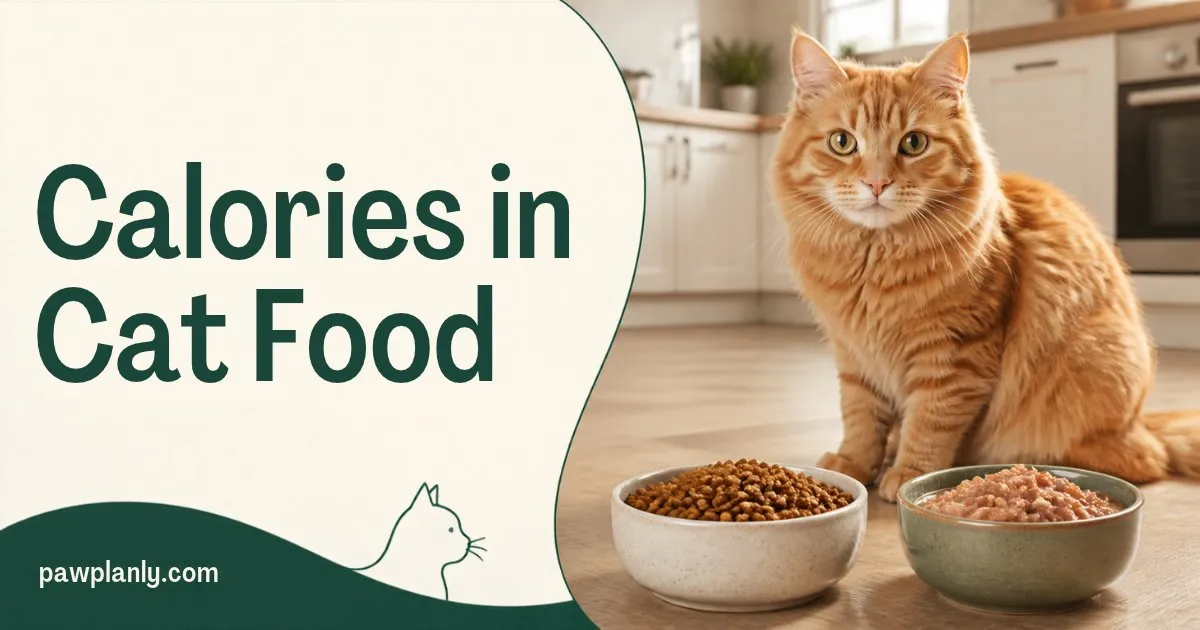
Most dry cat food has roughly 300 to over 500 calories per cup, and a 3 oz can of wet cat food usually has about 70–100 calories. Because wet food is mostly water, dry food often packs about 4 times the calories per gram. The only number you can trust for your cat is the Calorie Content statement on your own bag or can.
Once you know the calories in your food, enter them with your cat’s weight in our Cat Food Calculator to get cups or cans per day. For the bigger picture on portions, see how much to feed a cat.
Calories in cat food at a glance
Typical ranges for US cat foods. Your brand may be higher or lower.
| Food | Typical calories | Where to find it on the label |
|---|---|---|
| Dry food (kibble) | ~300 to 500+ kcal per 8 oz cup | kcal/kg and kcal/cup |
| Wet food, 3 oz (85 g) can | ~70–100 kcal per can | kcal/kg, often kcal/can |
| Wet food, 5.5 oz (156 g) can | ~130–185 kcal per can | kcal/kg, often kcal/can |
| Treats | Varies a lot | kcal/kg and kcal per treat or piece |
“kcal” and “calories” mean the same thing on pet food. One kcal is one food Calorie, the same unit you see on human food labels.
How to read the calories on a cat food label
AAFCO label rules say the calorie statement must appear under the heading “Calorie Content.” It must be given as kilocalories per kilogram (kcal/kg) of food as fed, and also per a familiar unit such as a cup or a can. The figure is metabolizable energy (ME), the energy your cat can actually use after digestion.
A typical statement looks like this:
Calorie Content (calculated): 3,800 kcal ME/kg; 400 kcal ME/cup
“Calculated” means the company worked it out from the nutrient levels. Some foods are tested in feeding trials instead.
Two things to watch for:
- Treats and toppers count too. They have their own calorie statement. Add them to the daily total.
- “Light,” “lite” and “low-calorie” foods must have a nutritionally meaningful cut in calories under AAFCO rules. “Less” or “reduced calorie” only means fewer calories than the comparison product named on the label, so the drop may be small.
How to convert kcal/kg to cups, cans and grams
If the label only shows kcal/kg, or you want to weigh food, use these simple formulas.
Calories per can or pouch:
kcal per can = kcal/kg × can weight in grams ÷ 1,000
A 3 oz can is about 85 g, so a food with 1,100 kcal/kg has 1,100 × 85 ÷ 1,000 = about 94 kcal per can.
Grams in a cup of dry cat food:
grams per cup = kcal per cup ÷ kcal/kg × 1,000
With 400 kcal/cup and 3,800 kcal/kg: 400 ÷ 3,800 × 1,000 = about 105 g per cup. Small, dense kibble weighs more per cup than large, airy kibble, which is why one cup of two brands can differ so much in calories.
Calories per gram (for kitchen-scale feeding):
kcal per gram = kcal/kg ÷ 1,000
A 3,600 kcal/kg food has 3.6 kcal per gram, so a 105 g portion is about 378 kcal. Weighing is more accurate than a scoop, which can easily hold 20–30% more than you think.
Dry vs. wet cat food: why the calories differ so much
The main difference is water. Cornell Feline Health Center notes that dry food has 6–10% moisture, semi-moist food about 35%, and canned food at least 75%. Water has no calories, so it dilutes the energy in wet food.
Compare two typical foods per 100 g (3.5 oz):
| Food | kcal/kg | Calories per 100 g |
|---|---|---|
| Dry food | 3,800 | ~380 kcal |
| Wet food | 940 | ~94 kcal |
That is about 4 times the calories per gram for the dry food. It is also why a cat can eat a much bigger volume of wet food for the same calories. The extra water can help cats that drink little and cats with urinary or kidney concerns, but ask your vet before changing food for a medical reason.
When you feed both, split the daily calories between them. Our guide on how much wet food to feed a cat has a wet-plus-dry table.
How to estimate calories if the label does not show them
Most US cat foods now carry a calorie statement. If yours is missing it (for example an older label or an imported food), you can make a rough estimate from the guaranteed analysis with the “modified Atwater” method AAFCO describes:
- Find carbohydrate (NFE): 100 − protein − fat − fiber − moisture − ash (all in %).
- Multiply: protein × 3.5, fat × 8.5, carbohydrate × 3.5.
- Add the three results and multiply by 10 to get kcal/kg.
Dry food example: 32% protein, 15% fat, 3% fiber, 10% moisture, 7% ash.
- Carbohydrate = 100 − 32 − 15 − 3 − 10 − 7 = 33%
- (32 × 3.5) + (15 × 8.5) + (33 × 3.5) = 112 + 127.5 + 115.5 = 355
- 355 × 10 = about 3,550 kcal/kg
Wet food example: 11% protein, 5% fat, 1% fiber, 78% moisture, 2.5% ash.
- Carbohydrate = 100 − 11 − 5 − 1 − 78 − 2.5 = 2.5%
- (11 × 3.5) + (5 × 8.5) + (2.5 × 3.5) = 38.5 + 42.5 + 8.75 = 89.75
- 89.75 × 10 = about 900 kcal/kg, or about 76 kcal in a 3 oz (85 g) can
Treat the result as a rough guide. The guaranteed analysis lists minimums and maximums, not exact amounts, and ash is often not listed at all. If you can, ask the manufacturer for the real figure.
How many calories does a cat need a day?
Vets start with the Resting Energy Requirement (RER) = 70 × (weight in kg)^0.75. Most spayed or neutered adults need about 1.2 × RER, and inactive indoor cats often need closer to 1.0 × RER.
| Cat weight | Calories per day (indoor to active) |
|---|---|
| 8 lb (3.6 kg) | ~185–220 |
| 10 lb (4.5 kg) | ~220–260 |
| 12 lb (5.4 kg) | ~250–300 |
These are for adult cats at a healthy weight. If your cat is overweight, see how much your cat should eat to lose weight. If your cat is too thin, see how to help a cat gain weight.
Don’t forget the calories in treats
Cornell Feline Health Center suggests keeping treats to no more than 10–15% of your cat’s daily calories. For a cat eating 240 kcal a day, that is about 24–36 kcal of treats. Check the kcal per treat on the bag. A few rich treats can use up that budget fast, and if you give many treats, reduce the meal amount slightly.
When to call the vet
Calories are a starting point. Call your vet if your cat:
- Has not eaten for 24 hours or is eating much less for more than a day or two. Cats that stop eating can develop fatty liver disease (hepatic lipidosis), which can be life-threatening.
- Loses or gains weight without a change in food or calories, or seems hungry all the time.
- Vomits often, has diarrhea, or drinks or urinates much more than usual.
- Has kidney disease, diabetes, urinary problems or another condition. These cats may need a prescription diet with a set daily amount.
- Needs to lose more than a little weight. Vets plan a safe rate of loss so the cat does not get sick.
The bottom line
Find the Calorie Content statement on your cat’s food, note the kcal per cup or can, and compare it with what your cat needs each day. Dry food is about 4 times as calorie-dense as wet food, so small measuring mistakes with kibble matter most. Weigh your cat every few weeks and adjust by about 10% if the weight moves. Food needs also shift with age, so check your cat’s life stage with the cat age calculator.
Turn your food’s calories into cups or cans per day →
Frequently asked questions
How many calories are in a cup of dry cat food?
Most dry cat foods have roughly 300 to over 500 calories (kcal) per 8 oz measuring cup. Light foods sit at the low end and rich foods at the high end. The exact number is in the Calorie Content statement on the bag.
How many calories are in a can of wet cat food?
A 3 oz can of wet cat food usually has about 70–100 calories, and a 5.5 oz can about 130–185. Brands differ a lot, so check the kcal per can or kcal/kg on the label.
Why does wet cat food have fewer calories than dry food?
Wet food is mostly water. Cornell Feline Health Center notes canned cat food is at least 75% moisture, while dry food has only 6–10%. Gram for gram, dry food often has about 4 times the calories of wet food.
How many grams are in a cup of dry cat food?
It depends on the kibble size and shape. Divide the kcal per cup by the kcal/kg on your bag, then multiply by 1,000. For example, 400 kcal/cup ÷ 3,800 kcal/kg × 1,000 = about 105 grams per cup. A kitchen scale is the most accurate way to measure.
How many calories should my cat eat a day?
A typical 10 lb spayed or neutered adult cat at a healthy weight needs about 220–260 calories a day. Less active indoor cats sit at the low end. Kittens, very active cats and cats that need to lose or gain weight need different amounts.
Sources
This guide is for general information and does not replace advice from your veterinarian. If you are worried about your pet, contact your vet. How we write our guides.