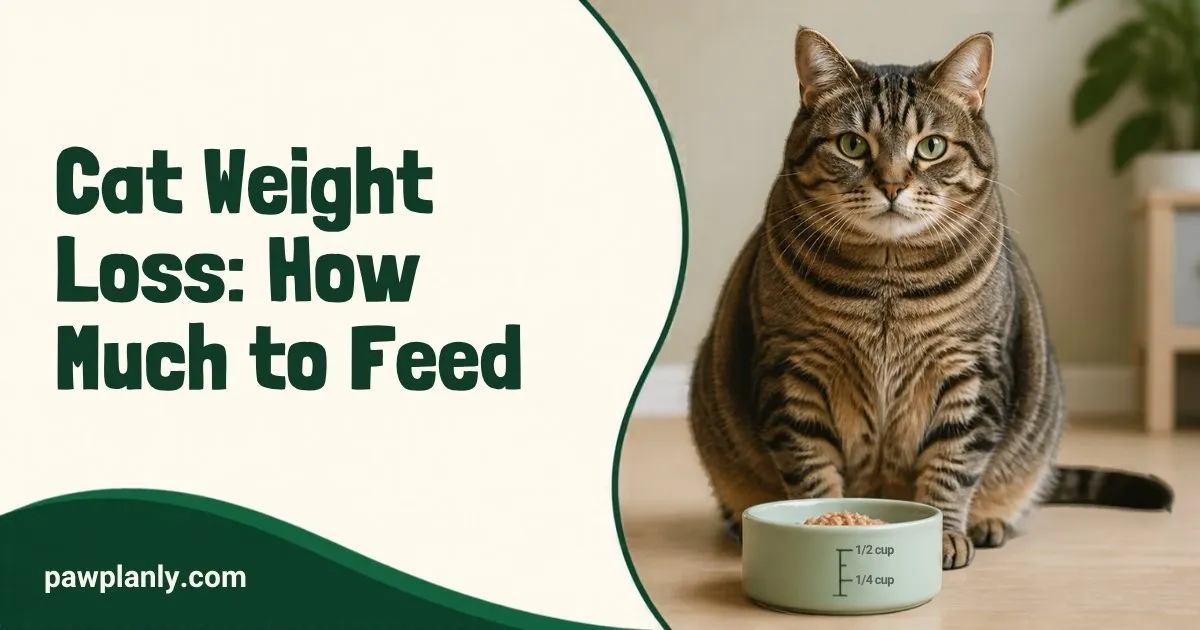
To lose weight, most cats should eat about 0.8 × their resting energy requirement (RER), worked out at their ideal weight, not their current weight. For a cat whose ideal weight is 10 lb, that’s about 175 calories a day: a little under 1/2 cup of a typical dry food, or about 2 small cans of wet food. Aim for slow, steady loss of no more than 1–2% of body weight per week.
To get your own cat’s number, use our Cat Food Calculator: enter your cat’s ideal weight and choose “Weight loss.” For normal daily portions (cats at a healthy weight), see our main guide on how much to feed a cat.
Step 1: Find your cat’s ideal weight
Everything starts with a target weight. Don’t guess this from a breed chart. Cats vary a lot in frame size, and a large-boned 13 lb cat can be lean while a small 10 lb cat can be overweight.
Your vet will use a body condition score to set an ideal weight. You can check the basics at home:
- Ribs: you should feel them easily under a thin layer of fat
- Waist: you should see a slight inward curve behind the ribs from above
- Belly: no big fat pad underneath (a loose, swinging “primordial pouch” is normal)
Cornell’s Feline Health Center describes feline obesity as body weight about 20% or more above normal. If your cat is 15 lb and the vet says the ideal is 11–12 lb, that’s a cat that needs a plan.
Step 2: Work out the calories for weight loss
Vets use the same formula our calculator uses:
RER = 70 × (ideal weight in kg)^0.75
Weight-loss calories = 0.8 × RER
Your vet may pick a slightly different starting point for your cat. Either way, it’s a starting number that you adjust based on how your cat actually loses weight.
Cat weight loss calorie chart (by ideal weight)
| Ideal weight | Calories/day for weight loss | Dry food (400 kcal/cup) | Wet food (80 kcal/can) |
|---|---|---|---|
| 7 lb (3.2 kg) | ~135 | ~1/3 cup | ~1.7 cans |
| 8 lb (3.6 kg) | ~145 | ~0.37 cup | ~1.8 cans |
| 9 lb (4.1 kg) | ~160 | ~0.40 cup | ~2.0 cans |
| 10 lb (4.5 kg) | ~175 | ~0.44 cup | ~2.2 cans |
| 11 lb (5.0 kg) | ~185 | ~0.47 cup | ~2.3 cans |
| 12 lb (5.4 kg) | ~200 | ~1/2 cup | ~2.5 cans |
| 13 lb (5.9 kg) | ~210 | ~0.53 cup | ~2.6 cans |
| 14 lb (6.4 kg) | ~225 | ~0.56 cup | ~2.8 cans |
Cups and cans are based on a 400 kcal/cup dry food and an 80 kcal can (about 3 oz). Your food is probably different, so always use the kcal number printed on your own bag or can.
Example: a 15 lb cat that should weigh 11 lb
Let’s say your vet tells you your 15 lb cat’s ideal weight is 11 lb.
- 11 lb = 5.0 kg
- RER = 70 × 5.0^0.75 ≈ 234 calories
- Weight-loss target = 0.8 × 234 ≈ 187 calories a day
With a 400 kcal/cup dry food, that’s just under 1/2 cup a day, split into 2–4 meals. At a safe pace of about 1% per week, going from 15 lb to 11 lb takes roughly 7 months. That sounds slow, but slow is the safe way for cats.
How fast should a cat lose weight?
Aim for no more than about 1–2% of body weight per week. Here’s what that looks like:
| Current weight | 1% per week | 2% per week |
|---|---|---|
| 12 lb | ~2 oz | ~4 oz |
| 15 lb | ~2.5 oz | ~5 oz |
| 18 lb | ~3 oz | ~6 oz |
These are small changes, so a bathroom scale won’t show them well. A baby scale or pet scale works much better. Weigh your cat every 2 weeks at the same time of day.
How to adjust:
- Not losing after 3–4 weeks? Cut the daily amount by about 10% and recheck.
- Losing more than 2% a week? Add about 10% more food.
- Losing steadily at 0.5–2% a week? Keep going and recheck every 2–4 weeks.
Never starve a cat to make it lose weight. Cats that stop eating, or lose weight too fast, can develop hepatic lipidosis (fatty liver disease), which can be life-threatening. Overweight cats are at higher risk. If your cat hasn’t eaten for 24 hours, call your vet.
Wet or dry food for weight loss?
Both can work. What matters most is the total calories each day. Still, there are some good reasons to use wet food, or a mix:
- More water, fewer calories per bite. Many cats feel fuller.
- Easy to portion. A can is a fixed amount.
- Encourages meals instead of free-feeding. Cornell’s Feline Health Center points out that a bowl of dry food left out all day makes overeating easy.
If you feed dry food, measure it with a proper measuring cup or, better, a kitchen scale in grams. A “scoop” can easily hold 20–30% more than you think.
Prescription weight-loss diets from your vet are another option. They are made to keep protein and nutrients high while calories are low, which matters when a cat eats much less food than before.
Tips that make cat weight loss work
- Count treats. Keep them under 10% of daily calories, and take them out of the meal amount.
- Split the food into small meals. 3–4 small meals, or a puzzle feeder, keeps cats busy and less likely to beg.
- Feed pets separately if one cat steals the other’s food.
- Add play. Two or three short play sessions a day with a wand toy burns energy and helps with boredom eating.
- Everyone in the house follows the plan. Extra snacks from one family member can stop weight loss completely.
- Recalculate when weight changes a lot or when you switch foods.
Once your cat reaches its ideal weight
When your cat hits the goal weight, slowly raise food to a maintenance amount. For most spayed or neutered indoor cats, that’s about 1.0–1.2 × RER. Do this in small steps (about 10% at a time) and keep weighing your cat every few weeks, as weight can come back easily. Our Cat Food Calculator shows the maintenance number too.
Needs also change with age. Many middle-aged cats gain weight easily, while some senior cats lose weight. Check your cat’s life stage with the cat age calculator.
When to call the vet
Talk to your vet before starting a diet, and call sooner if you see any of these:
- Your cat stops eating or eats very little for a day or more
- Weight loss is faster than 2% a week, or your cat is losing weight without a diet
- Vomiting, diarrhea, lethargy or hiding
- Yellow gums, skin or inner ears (a sign of liver problems)
- More drinking and peeing than usual (a possible sign of diabetes)
Unplanned weight loss in a cat can be a sign of illness, such as hyperthyroidism, diabetes or kidney disease, so it always needs a vet check.
The bottom line
Feed for your cat’s ideal weight, not its current weight. Start at about 0.8 × RER, measure every meal, weigh your cat every 2 weeks, and aim for slow loss of 1–2% a week or less. Calculate your cat’s weight-loss portions now →
Frequently asked questions
How many calories should a 15 lb cat eat to lose weight?
It depends on the cat's ideal weight, which your vet sets. If a 15 lb cat's ideal weight is 11 lb, a common starting point is about 185–190 calories a day (0.8 × RER at 11 lb). Weigh the cat every 2 weeks and adjust.
How fast should a cat lose weight?
Slowly. Aim for no more than about 1–2% of body weight per week. For a 15 lb cat, that is about 2.5–5 oz a week. Faster loss raises the risk of fatty liver disease (hepatic lipidosis).
How much dry food should my cat eat to lose weight?
Divide the daily calorie target by the kcal per cup on the bag. For example, 175 calories of a 400 kcal/cup food is a little under 1/2 cup a day (about 0.44 cup). Use a measuring cup or kitchen scale, not a scoop.
Is wet food better for cat weight loss?
It can help. Wet food has more water and fewer calories per bite, so many cats feel full on fewer calories, and it makes measured meals easy. What matters most is the total calories per day.
Can I just cut my cat's food in half?
Don't make big cuts on your own. Work out a calorie target based on your cat's ideal weight, ideally with your vet. A cat that suddenly eats much less or stops eating can develop serious liver disease.
Sources
This guide is for general information and does not replace advice from your veterinarian. If you are worried about your pet, contact your vet. How we write our guides.