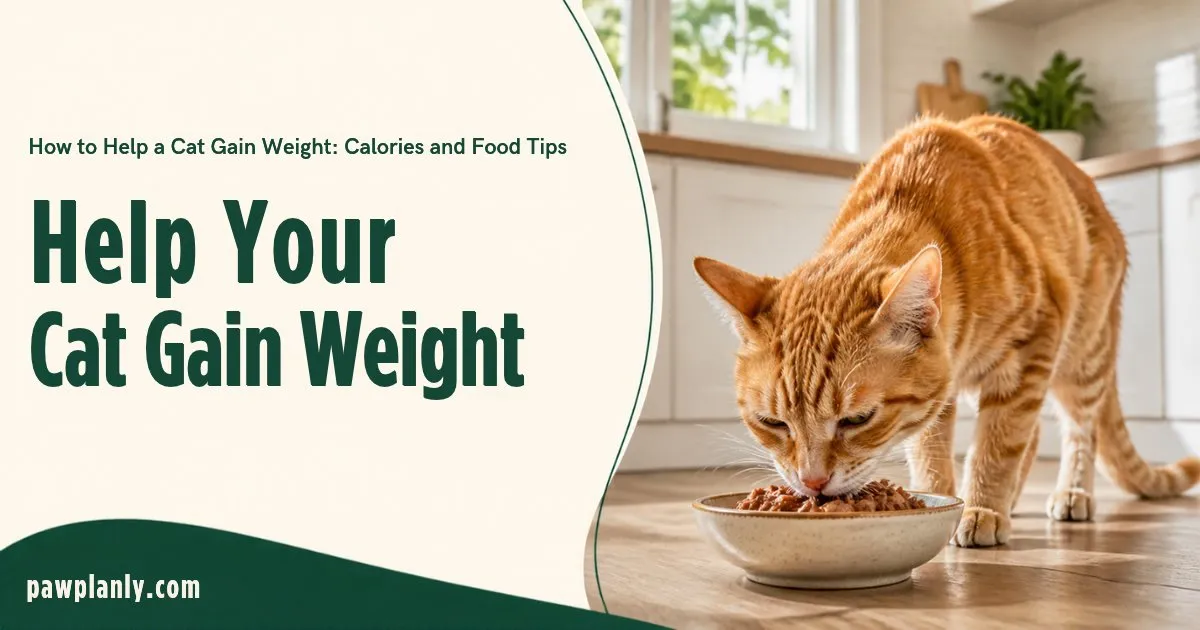
To help a cat gain weight, first have your vet find out why it is thin, then feed the calories for its target weight, in small meals of a food it likes, and raise the amount slowly. For a spayed or neutered adult cat whose target is 9 lb, that is about 240 calories a day, compared with about 200 for the same cat at 7 lb.
You can work out your own cat’s number with our Cat Food Calculator: enter the target weight your vet gives you. For normal daily portions, see our guide on how much to feed a cat.
Is my cat underweight? Signs to check
Weight alone doesn’t tell you much, because cats have very different frame sizes. Vets use a body condition score (BCS). On the common 9-point scale from WSAVA, 5 is ideal and 1–3 means too thin.
Signs your cat may be underweight:
- Ribs are easy to see or feel with almost no fat over them
- The spine and hip bones stand out when you run a hand along the back
- A very deep waist from above and a tucked-up belly from the side
- Loss of muscle over the back and back legs (common in older cats)
- A dull, scruffy coat, or your cat feels “bony” when you pick it up
If you are not sure, weigh your cat on a baby or pet scale and write the number down. A steady drop over a few weeks matters more than any single number.
Why cats lose weight: see the vet first
This step matters more than any feeding tip. Weight loss in an adult cat is very often a sign of illness, and more food won’t fix the cause. Common reasons include:
| What you notice | Possible causes |
|---|---|
| Losing weight but eating normally or more | Hyperthyroidism, diabetes, intestinal disease, parasites |
| Eating less, drooling or dropping food | Dental disease or mouth pain |
| Eating less, drinking and peeing more | Kidney disease, diabetes |
| Older cat slowly getting thinner | Age-related muscle loss, kidney disease, hyperthyroidism, cancer |
| Thin after illness, surgery or a move | Stress, pain, recovery |
According to Cornell’s Feline Health Center, hyperthyroidism is a common disease that mostly affects middle-aged and older cats, and its most common signs are weight loss, a bigger appetite, and more drinking and peeing. Many of these problems can be treated, and cats often put weight back on once they are.
Some cats are thin for simpler reasons: another pet eats their food, the bowl is in a busy or scary spot, or a recent food change didn’t go well. Your vet can help you rule out illness first.
How many calories does a cat need to gain weight?
Vets estimate calories with the resting energy requirement (RER), the same formula our calculator uses:
RER = 70 × (weight in kg)^0.75
Maintenance for a spayed/neutered adult ≈ 1.2 × RER
To gain weight, a practical starting point is to feed the maintenance calories for the target weight, not the current weight. Your vet may choose a different number for your cat, for example during recovery from illness. Either way, treat it as a starting point and adjust.
Calorie chart by target weight
| Target weight | Calories/day (1.2 × RER) | Dry food (400 kcal/cup) | Wet food (80 kcal/can) |
|---|---|---|---|
| 6 lb (2.7 kg) | ~180 | ~0.45 cup | ~2.2 cans |
| 7 lb (3.2 kg) | ~200 | ~1/2 cup | ~2.5 cans |
| 8 lb (3.6 kg) | ~220 | ~0.55 cup | ~2.8 cans |
| 9 lb (4.1 kg) | ~240 | ~0.6 cup | ~3 cans |
| 10 lb (4.5 kg) | ~260 | ~0.65 cup | ~3.3 cans |
| 11 lb (5.0 kg) | ~280 | ~0.7 cup | ~3.5 cans |
| 12 lb (5.4 kg) | ~300 | ~3/4 cup | ~3.7 cans |
Cups and cans assume a 400 kcal/cup dry food and an 80 kcal can (about 3 oz). Check the kcal on your own food’s label, as foods vary a lot.
Example: a 7 lb cat that should weigh 9 lb
- Target weight 9 lb = 4.1 kg
- RER = 70 × 4.1^0.75 ≈ 200 calories
- Maintenance at target = 1.2 × 200 ≈ 240 calories a day
Your cat now eats about 200 calories a day (maintenance at 7 lb). Don’t jump straight to 240. Raise food by about 10% at a time (about 20 calories here) every week or two, as long as your cat eats it all and has normal stools.
What to feed a cat to gain weight
The best weight-gain food is a complete and balanced food that your cat actually eats. Some good options:
- Energy-dense foods. Kitten foods and some “high-calorie” or recovery diets pack more calories into each bite, which helps cats that only eat small amounts. Ask your vet first if your cat has kidney disease or another condition that needs a special diet.
- Wet food your cat loves. Many thin cats eat more of a tasty wet food. Warming it slightly, to around body temperature (never hot), makes it smell stronger and can tempt a picky eater.
- Mixing wet and dry. Dry food has more calories per bite. Leaving a measured amount of dry food out lets a cat graze, while wet meals add variety.
- Prescription diets. For cats with illness, your vet may recommend a specific diet. Our wet food feeding guide shows how to count cans if you use one.
Avoid “fattening up” a cat with milk, tuna made for people, table scraps or lots of treats. These can upset the stomach and don’t give balanced nutrition. Keep treats under about 10% of daily calories.
Feeding tips that help a thin cat eat more
- Small meals, more often. 4–6 small meals a day are easier for a cat with a small appetite than 2 big ones.
- Fresh food every time. Many cats refuse wet food that has sat out. Remove leftovers after about 30 minutes.
- A quiet, safe spot. Feed away from the litter box, loud appliances and other pets.
- Feed pets separately so a bossy cat or dog can’t steal the food.
- Wide, shallow dishes. Some cats dislike deep bowls that touch their whiskers.
- Switch foods slowly, over about 7–10 days, mixing a little more of the new food each day.
- Weigh every 1–2 weeks and write it down, so you and your vet can see if the plan is working.
Special cases: seniors, kidney disease and recovery
Senior cats often lose muscle and weight with age, but this should still be checked by a vet, since hyperthyroidism and kidney disease are common in older cats. See where your cat is in life with our cat age calculator, and ask about checkups at least once or twice a year for older cats.
Cats with kidney disease often lose their appetite. Don’t switch them to a high-protein or high-phosphorus food without talking to your vet. Your vet can choose a kidney-friendly diet and may prescribe an appetite stimulant or anti-nausea medicine.
Cats recovering from illness or surgery may need a recovery diet, appetite stimulants or, in serious cases, a feeding tube placed by your vet. Never force-feed a cat at home without your vet’s guidance, as it can cause food aversion or choking.
A cat that stops eating is an emergency. Cats that stop eating, especially overweight cats, can develop hepatic lipidosis (fatty liver disease), which can be life-threatening. Call your vet if your cat hasn’t eaten for about 24 hours.
When to call the vet
Call your vet before starting a weight-gain plan, and right away if you notice:
- Your cat hasn’t eaten for about 24 hours, or eats much less than usual
- Weight loss while eating normally or more
- More drinking and peeing, vomiting or diarrhea
- Drooling, bad breath or dropping food while eating
- Yellow gums, skin or inner ears, hiding or weakness
- No weight gain after 3–4 weeks of feeding more
The bottom line
Get a vet check first, since thin cats are often sick cats. Then feed for the target weight, in small fresh meals of a food your cat likes, increase slowly and weigh every 1–2 weeks. If your cat is on the other side of the scale, see how much your cat should eat to lose weight. Calculate your cat’s daily calories now →
Frequently asked questions
How many calories does a cat need to gain weight?
A practical starting point is the maintenance calories for your cat's target weight, not its current weight. For a spayed or neutered adult with a 9 lb target, that is about 240 calories a day (1.2 × RER at 9 lb). Raise food in small steps of about 10% and weigh your cat every 1–2 weeks. Your vet should set the target.
What can I feed my cat to help her gain weight?
Use a complete and balanced food your cat likes, ideally an energy-dense one such as a kitten food or a vet-recommended recovery or high-calorie diet. Offer small meals several times a day and warm wet food slightly to make it smell stronger. Human foods and extra treats are not a good way to add calories.
Why is my cat losing weight but still eating?
Weight loss with a normal or bigger appetite is a classic sign of hyperthyroidism or diabetes, which are common in older cats. Intestinal disease and parasites can also cause it. Feeding more food will not fix these problems, so your cat needs a vet check and blood tests.
How fast should a cat gain weight?
Slowly and steadily. Gain over several weeks to a few months is normal. Increase food in small steps instead of doubling meals, which can cause vomiting or diarrhea. Your vet can give a target for your cat's condition.
Is it dangerous if my cat stops eating?
Yes. A cat that stops eating can develop hepatic lipidosis (fatty liver disease), which can be life-threatening. Call your vet if your cat has not eaten for about 24 hours.
Sources
This guide is for general information and does not replace advice from your veterinarian. If you are worried about your pet, contact your vet. How we write our guides.