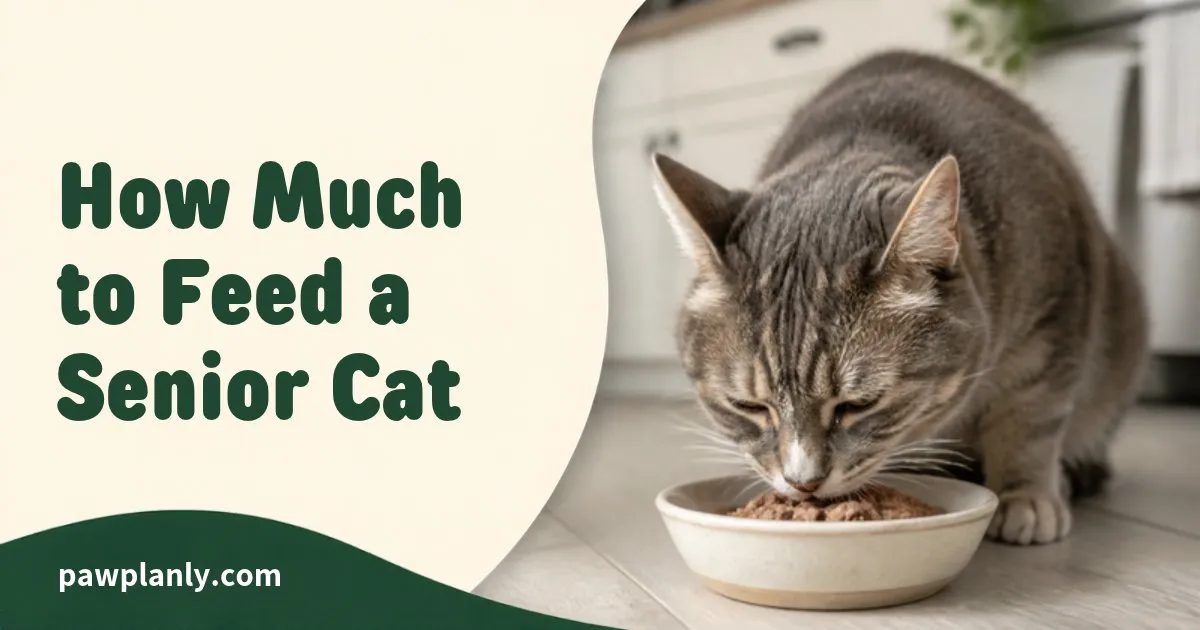
A healthy senior cat at a good weight usually needs about 20–30 calories per pound a day, so a 10 lb senior cat needs roughly 220–260 calories. That is about 1/2–2/3 cup of a typical dry food or about 3 small (3 oz) cans of wet food. Less active cats need the lower amount, while many cats over about 11 need the higher amount, or more, to hold their weight and muscle.
To get a number for your own cat and your own food, use our Cat Food Calculator. For general portions at any age, see how much to feed a cat.
When is a cat a senior?
Vets usually call cats mature at about 7–10 years and senior from about 10 years. VCA notes that some cats can be considered senior at 8 or even younger. Not sure where your cat is? Check with our cat age calculator or the chart in cat years to human years. A 10-year-old cat is about 56 in human years.
Age alone does not set the food amount. Two 12-year-old cats can need very different amounts, so the cat’s weight, muscle and activity matter more than the birthday.
Do senior cats need more or fewer calories?
Both can be true, depending on the stage:
- Mature cats (about 7–10): often slow down and gain weight easily. Many do best near the low end of the range.
- Older seniors (from about 11–12): energy needs often go up again. Many older cats digest fat and protein less well, so they absorb less from the same bowl of food. This is one reason some older cats slowly lose weight and muscle while eating normally.
So a cat that needed less food at 8 may need more at 14. Weigh your cat regularly and let the scale guide you.
Senior cat feeding chart by weight
Vets start with the Resting Energy Requirement (RER) = 70 × (weight in kg)^0.75. Inactive or weight-prone cats usually need about 1.0 × RER, and typical spayed or neutered adults about 1.2 × RER. Use your cat’s ideal weight, not its current weight if it is overweight.
Daily amounts using an example dry food of 400 kcal per cup and wet food of 80 kcal per 3 oz can (to find the numbers for your own food, see calories in cat food):
| Ideal weight | Calories/day (low to typical) | Dry food (400 kcal/cup) | 3 oz cans (80 kcal) |
|---|---|---|---|
| 6 lb (2.7 kg) | 150–180 | 0.37–0.44 cup | 1.9–2.2 |
| 8 lb (3.6 kg) | 185–220 | 0.46–0.55 cup | 2.3–2.8 |
| 10 lb (4.5 kg) | 220–260 | 0.54–0.65 cup | 2.7–3.3 |
| 12 lb (5.4 kg) | 250–300 | 0.62–0.75 cup | 3.1–3.7 |
| 14 lb (6.4 kg) | 280–335 | 0.70–0.84 cup | 3.5–4.2 |
| 16 lb (7.3 kg) | 310–370 | 0.77–0.93 cup | 3.9–4.6 |
These are starting points. The Merck Veterinary Manual notes that any single animal may need as much as 30% more or less than the formula gives. Your cat’s body is the final test.
How to tell if you are feeding the right amount
Weigh your senior cat at home or at the clinic every month or two, and write it down. Then:
- Weight steady and ribs easy to feel under a thin layer of fat: keep the amount the same.
- Slowly gaining: cut the daily amount by about 10% and recheck in 2–4 weeks.
- Slowly losing: see your vet first, then add about 10% if the vet finds no illness.
Also check muscle, not just fat. In older cats, muscle loss shows first over the spine, hips and back legs. A cat can look thin over the back while still having a fat belly. Ask your vet to score both body condition and muscle condition at each checkup. VCA recommends checkups twice a year for senior cats.
Wet or dry food for a senior cat?
Both can work if the food is labeled complete and balanced for adult maintenance or all life stages. Wet food has some real benefits for older cats:
- Canned cat food is at least 75% water, according to Cornell. That helps cats that drink little, and extra water is often helpful for kidney and urinary health.
- It is soft, which helps cats with sore teeth or missing teeth.
- The smell often tempts picky older eaters.
Many owners mix both. Work out the daily calories, give the wet food, then fill the rest with measured dry food. Our guide on how much wet food to feed a cat shows how to read the kcal per can and how to split wet and dry.
Do senior cats need senior cat food?
Not always. There are no official nutrient standards for senior cat food in the US, so “senior” formulas differ a lot. Some are lower in calories, which suits a mature, weight-prone cat but may be too little for a thin 15-year-old.
- Healthy senior at a good weight: can usually stay on a good complete and balanced adult food.
- Protein: protein helps older cats keep muscle. Do not cut protein in a healthy senior cat on your own.
- Kidney disease: your vet may suggest a kidney diet with controlled phosphorus. Use the amount your vet gives you.
Change foods slowly over 7–10 days, mixing more of the new food each day. Older cats can be picky and sensitive to sudden changes.
Feeding tips for older cats
- Small, frequent meals: split the day into 2–4 meals. It suits smaller appetites and shows you right away if your cat skips a meal.
- Measure every meal with a real measuring cup or a kitchen scale.
- Keep treats under 10% of daily calories. For a 10 lb senior cat, that is about 22–26 calories.
- Make eating comfortable: raise the bowl a little for cats with stiff necks or arthritis, and use wide, shallow dishes.
- Warm wet food slightly by adding a little warm water. Many older cats eat better when food smells stronger.
- Fresh water in several places, or a fountain, helps cats drink more.
When to call the vet
Call your vet if your senior cat:
- Has not eaten for 24 hours, or is eating much less for more than a day or two. Cats that stop eating can get fatty liver disease (hepatic lipidosis), which can be life-threatening.
- Is losing weight, especially with a normal or bigger appetite. Hyperthyroidism, diabetes and kidney disease are common in older cats. See our guide on how to help a cat gain weight, but get a vet check first.
- Drinks or pees much more than usual, vomits often, or has diarrhea.
- Drops food, chews on one side or drools, which can mean painful teeth.
- Is gaining weight even though you have not changed the food. If your cat needs to slim down, follow our guide on how much your cat should eat to lose weight.
The bottom line
Start with about 20–30 calories per pound of ideal weight, measure every meal, and weigh your senior cat every month or two. Mature cats often need a bit less, while many cats over 11 need a bit more. Any steady weight loss deserves a vet visit.
Work out your senior cat’s daily portions now →
Frequently asked questions
How many calories should a senior cat eat a day?
Most healthy senior cats at a good weight need about 20–30 calories per pound a day. A 10 lb senior cat usually needs about 220–260 calories. Less active cats sit at the low end, and many cats over about 11 need the higher end or a little more to keep weight and muscle on.
How much wet food should a senior cat eat?
A 10 lb senior cat needing about 220–260 calories eats roughly 2.7–3.3 small (3 oz) cans a day if each can has about 80 kcal. Check the kcal per can on your label, because brands differ a lot.
Should senior cats eat less?
Not always. Many cats need fewer calories in their mature years (about 7–10), but many older seniors need the same or more, because they may digest fat and protein less well. Feed to keep a healthy body and muscle condition, not by age alone.
How often should I feed a senior cat?
Split the daily amount into 2–4 small meals. Small meals are easier for older cats with a smaller appetite or dental problems, and they make it easier to notice if your cat stops eating.
Do senior cats need senior cat food?
There are no official nutrient standards for senior cat food, so senior formulas vary a lot. A healthy older cat can stay on a complete and balanced adult food. Cats with kidney disease or other conditions may need a specific diet chosen by your vet.
Sources
This guide is for general information and does not replace advice from your veterinarian. If you are worried about your pet, contact your vet. How we write our guides.